★ Host Guest Platform

Designing a C2C housing platform that encourages users to confidently complete a booking.

Role

UI/UX Designer

Team

2 UX Designers, 1 Product Manager, 2 Developers


Timeline

May - Aug 2025

Tools/Skills

UX Research, UI Design, Figma, Miro

DRIVING STATEMENT

Users feel skeptical of completing a booking to pay and live with a stranger.

Students and travelers face limited, costly, and impersonal traditional housing options. Host Guest enables a safe and efficient way to connect hosts and guests through secure booking.

DRIVING STATEMENT

Users feel skeptical of completing a booking to pay and live with a stranger.

Students and travelers face limited, costly, and impersonal traditional housing options. Host Guest enables a safe and efficient way to connect hosts and guests through secure booking.

DRIVING STATEMENT

Users feel skeptical of completing a booking to pay and live with a stranger.

Students and travelers face limited, costly, and impersonal traditional housing options. Host Guest enables a safe and efficient way to connect hosts and guests through secure booking.

The solution

An intuitive and reliable booking journey that enhances user confidence,
reducing drop-off by 85%
An intuitive and reliable booking journey that enhances user confidence, reducing drop-off by 85%

RESEARCH GOALS

What I'm looking for:
  • Identify specific trust signals users need to complete the booking process.

  • Optimize microflows and layout to reduce abandonment.

  • Identify specific trust signals users need to complete the booking process.

  • Optimize microflows and layout to reduce abandonment.

  • Identify specific trust signals users need to complete the booking process.

  • Optimize microflows and layout to reduce abandonment.

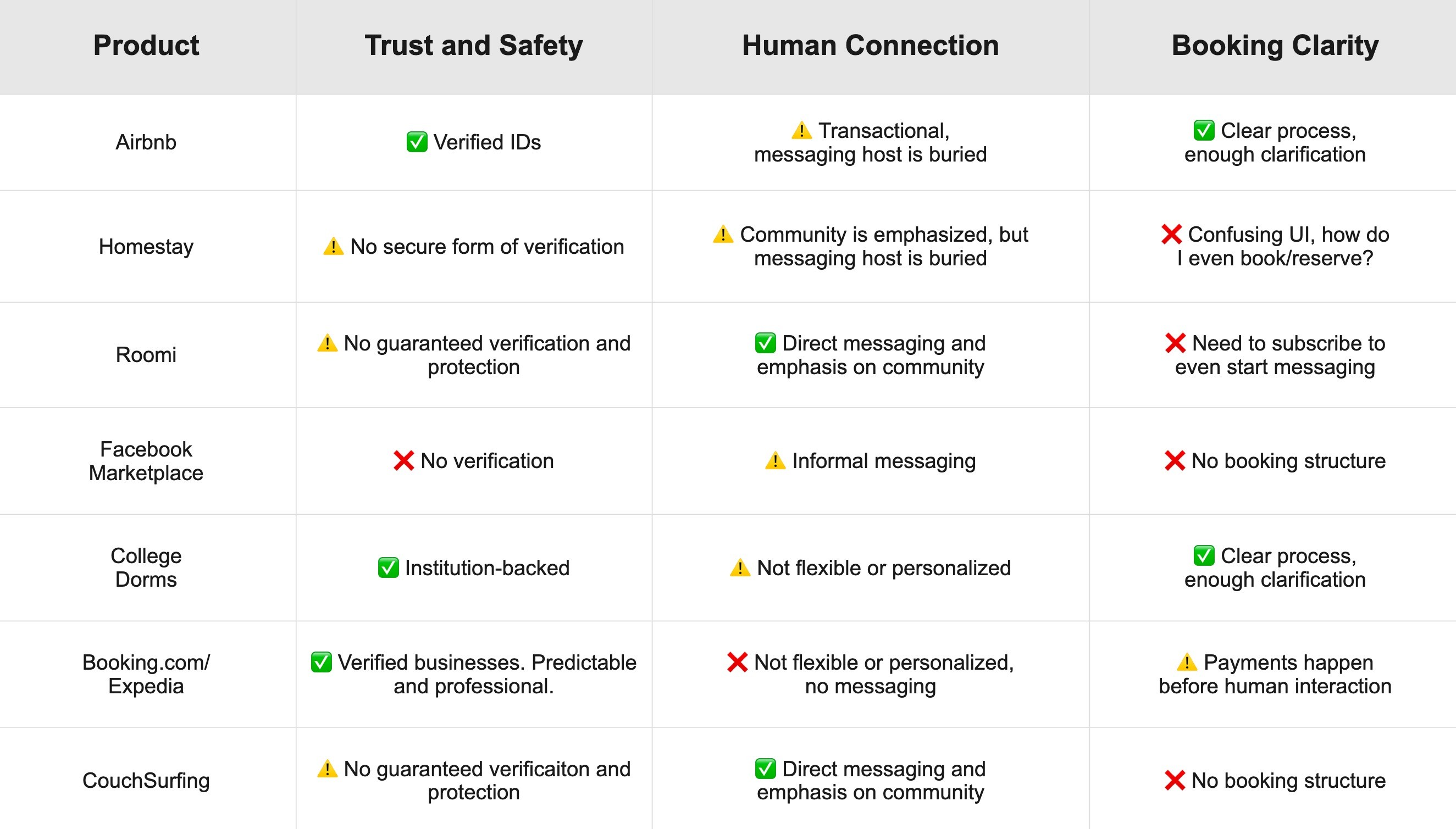
Competitor analysis

What works/doesn't work with existing booking flows?

Initial research results

What competitor pain points can be turned into Host Guest's strengths?

Transparent
verification

  • Verified ID badge

  • Host liability insurance coverage

  • Verified ID badge

  • Host liability insurance coverage

  • Verified ID badge

  • Host liability insurance coverage

Pre-booking communication with Host


  • Message before booking option

  • Reservation before payment

  • Message before booking option

  • Reservation before payment

  • Message before booking option

  • Reservation before payment

Guided, transparent booking flow

  • Visible, clarifying information

  • Clear next steps

  • Visible, clarifying information

  • Clear next steps

  • Visible, clarifying information

  • Clear next steps

Low-fi wireframes and user testing

Testing early concepts with target group.

I created rough mockups to test with 12 people from my target audience (4 international students, 4 domestic students/grads, and 4 frequent travelers). I asked the following guiding questions to gain insight into what's happening in their minds. I also asked them to think out loud.

AFFINITY DIAGRAM

From the interviews and testing, I created an affinity diagram.

Here are the common pain points from the interviews:

A/B TESTING

Syncing with the other UX designer who is designing the host side.

The other UX design intern, Jordan, was building the host perspective of the platform. We did our best to sync our designs, but sometimes our designs turned out completely different - like the booking dashboard page. We decided to take this as an opportunity to conduct A/B testing with our previous interview participants so we can create a more consistent and user-friendly design system across the two main user groups of the platform.

B (Jordan's)

A (mine)

Final Booking Status design

The participants critiqued the two designs above which informed our final design.

The participants critiqued the two designs above which informed our final design.

The participants critiqued the two designs above which informed our final design.

FINAL DESIGN

The user trust rate went from 4.2/10 → 8/10 for the MVP after the iterations.

When users land on the explore page, they start with basic filters to find homes, then refine their search with more specific options.

When the user clicks on a listing, they can see detailed info on the home and the host, as well as clear CTA buttons and guidance on next steps.

The user can message the host before reserving, increasing human interaction before making a decision. The user is also notified that verification is required for everyone, further soldifying the security.

After making a reservation, the user will be directed to their dashboard where they can clearly see their booking status.

+ The Messages, Finance, and Connections page as more follow-up tools!

Filter homes to fit user criteria
1.
View listing with detailed info
2.
Message and verify before reserving
3.
Stay updated on reservation and payment status
4.

Making designs consistent for all user groups

I was in charge of the guest flow, while the other UX Design Intern handled the host flow. Since many guest features had to align seamlessly with host features, this collaboration taught me the importance of constantly syncing with other designers to make sure every user group is experiencing a consistent product.

Understanding the Developers' and PM's POV

Collaborating closely with the Product Manager and developers gave me valuable insight into the backend of building a platform. We regularly discussed financial, technical, and scope constraints in weekly meetings, and I iterated on my designs to align with those realities.

Skills I gained from this experience

Skills I gained from this experience

Making designs consistent for all user groups

I was in charge of the guest flow for this internship, and I worked closely with the other UX Design Intern, who worked on the host flow. Since many guest features had to align seamlessly with host features, this collaboration taught me the importance of constantly syncing with other designers to make sure all perspectives of the product are consistent with the design system.

Understanding the Developers' and PM's POV

Collaborating closely with the Product Manager and developers gave me valuable insight into the backend of building a platform. We regularly discussed financial, technical, and scope constraints in weekly meetings, and I iterated on my designs to align with those realities.

★ Host Guest Platform

Designing a C2C housing booking flow that encourages users to get from point A → B.

Role

UI/UX Designer

Team

2 UX Designers, 1 Product Manager, 2 Developers


Timeline

May - Aug 2025

Tools/Skills

UX Research, UI Design, Figma, Miro

The solution

An intuitive and reliable booking journey that enhances user confidence, reducing drop-off by 85%

RESEARCH GOALS

What I'm looking for:

  • Identify specific trust signals users need to complete the booking process.

  • Optimize microflows and layout to reduce abandonment.

Transparent
verification

  • Verified ID badge

  • Host liability insurance coverage

Pre-booking communication with Host


  • Message before booking option

  • Reservation before payment

Guided, transparent booking flow

  • Visible, clarifying information

  • Clear next steps

Low-fi wireframes and user testing

Testing early concepts with target group.

I created rough mockups to test with 12 people from my target audience (4 international students, 4 domestic students/grads, and 4 frequent travelers). I asked the following guiding questions to gain insight into what's happening in their minds. I also asked them to think out loud.

AFFINITY DIAGRAM

From the interviews and testing, I created an affinity diagram.

Here are the common pain points from the interviews:

A

B

Final Booking Status Design

The participants critiqued the two designs above which informed our final design.

A/B TESTING

Syncing with the other UX designer who is designing the host side.

The other UX design intern was building the host perspective of the platform. We did our best to sync our designs, but sometimes our designs turned out completely different - like the booking dashboard page. We decided to take this as an opportunity to conduct A/B testing with our previous interview participants so we can create a more consistent and user-friendly design system across the two main user groups of the platform.

Competitor analysis

What works/doesn't work with existing booking flows?

DRIVING STATEMENT

Users feel skeptical of completing a booking to pay and live with a stranger.

Students and travelers face limited, costly, and impersonal traditional housing options. Host Guest enables a safe and efficient way to connect hosts and guests through secure booking.

Skills I gained from this experience

Making designs consistent for all user groups

I was in charge of the guest flow for this internship, and I worked closely with the other UX Design Intern, who worked on the host flow. Since many guest features had to align seamlessly with host features, this collaboration taught me the importance of constantly syncing with other designers to make sure all perspectives of the product are consistent with the design system.

Understanding the Developers' and PM's POV

Collaborating closely with the Product Manager and developers gave me valuable insight into the backend of building a platform. We regularly discussed financial, technical, and scope constraints in weekly meetings, and I iterated on my designs to align with those realities.

★ Host Guest Platform

Designing a C2C housing booking flow that encourages users to get from point A → B.

Role

UI/UX Designer

Team

2 UX Designers, 1 Product Manager, 2 Developers


Timeline

May - Aug 2025

Tools/Skills

UX Research, UI Design, Figma, Miro

RESEARCH GOALS

What I'm looking for:

  • Identify specific trust signals users need to complete the booking process.

  • Optimize microflows and layout to reduce abandonment.

Initial research results

So, what competitor pain points can be turned into Host Guest's strengths?

Transparent
verification

  • Verified ID badge

  • Host liability insurance coverage

Pre-booking communication with Host


  • Message before booking option

  • Reservation before payment

Guided, transparent booking flow

  • Visible, clarifying information

  • Clear next steps

Low-fi wireframes and user testing

Testing early concepts with target group

I created rough mockups to test with 12 people from my target audience (4 international students, 4 domestic students/grads, and 4 frequent travelers). I asked the following guiding questions to gain insight into what's happening in their minds. I also asked them to think out loud.

AFFINITY DIAGRAM

From the interviews and testing, I created an affinity diagram.

Here are the common pain points from the interviews:

A

B

Final Booking Status Design

A/B TESTING

Syncing with the other UX designer who is designing the host side.

The other UX design intern was building the host perspective of the platform. We did our best to sync our designs, but sometimes our designs turned out completely different - like the booking dashboard page. We decided to take this as an opportunity to conduct A/B testing with our previous interview participants so we can create a more consistent and user-friendly design system across the two main user groups of the platform.

Competitor analysis

What works/doesn't work with existing booking flows?

The solution

An intuitive and reliable booking journey that enhances user confidence, reducing drop-off by 85%

DRIVING STATEMENT

Users feel skeptical of completing a booking to pay and live with a stranger.

Students and travelers face limited, costly, and impersonal traditional housing options. Host Guest enables a safe and efficient way to connect hosts and guests through secure booking.

jlee88@risd.edu

Linkedin

Jessalyn © 2025

Made with 🩷, ☕️

jlee88@risd.edu

Linkedin

Jessalyn © 2025

Made with 🩷, ☕️

jlee88@risd.edu

Linkedin

Jessalyn © 2025

Made with 🩷, ☕️

FINAL DESIGN

The user trust rate went from 4.2/10 → 8/10 for the MVP after the iterations.

Filter homes to fit user criteria
1.

When users land on the explore page, they start with basic filters to find homes, then refine their search with more specific options.

View listing with detailed info
2.

When the user clicks on a listing, they can see detailed info on the home and the host, as well as clear CTA buttons and guidance on next steps.

Message and verify before reserving
3.

The user can message the host before reserving, increasing human interaction before making a decision. The user is also notified that verification is required for everyone, further soldifying the security.

Stay updated on reservation and payment status
4.

After making a reservation, the user will be directed to their dashboard where they can clearly see their booking status.

+ The Messages, Finance, and Connections page as more follow-up tools!

FINAL DESIGN

The user trust rate went from 4.2/10 → 8/10 for the MVP after the iterations.

Filter homes to fit
user criteria
1.

When users land on the explore page, they start with basic filters to find homes, then refine their search with more specific options.

View listing with detailed info
2.

When the user clicks on a listing, they can see detailed info on the home and the host, as well as clear CTA buttons and guidance on next steps.

Message and verify before reserving
3.

The user can message the host before reserving, increasing human interaction before making a decision. The user is also notified that verification is required for everyone, further soldifying the security.

Stay updated on reservation and payment status
4.

After making a reservation, the user will be directed to their dashboard where they can clearly see their booking status.